
Something odd is happening in enterprise AI right now, and it isn't the thing most executives are bracing for.
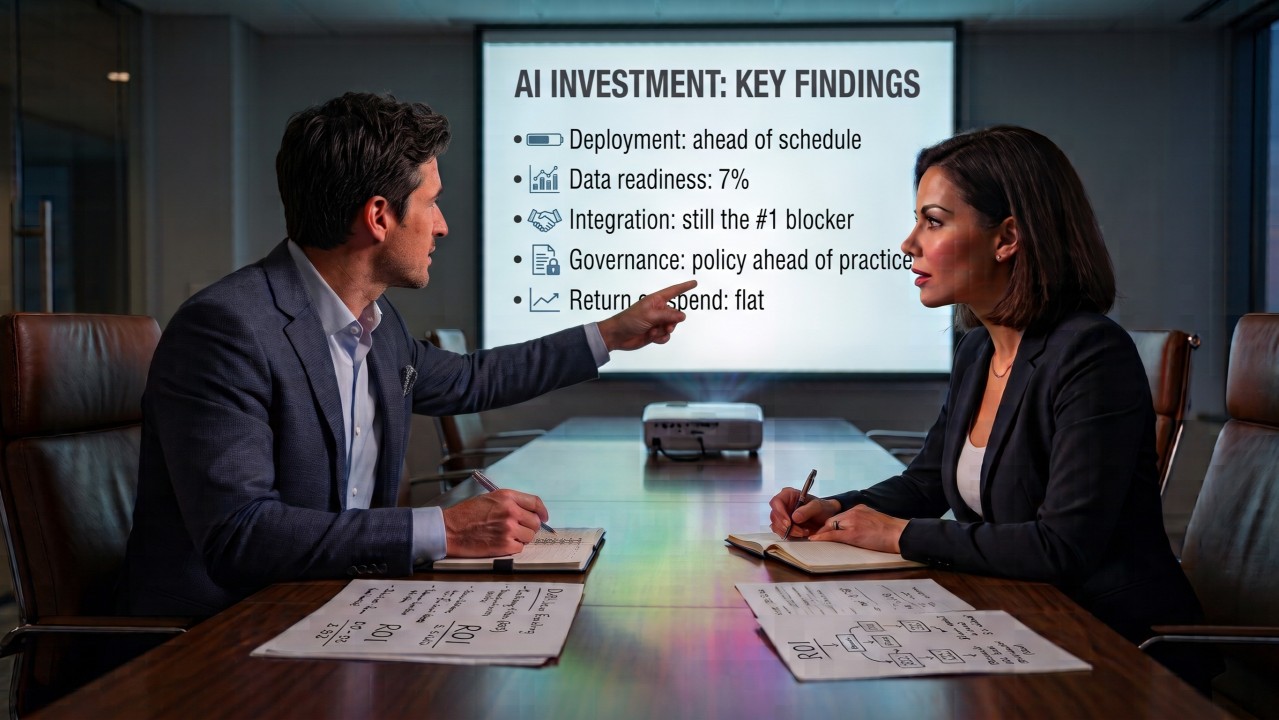
Ask a room of leaders whether their organisation is ready for AI, and a large share will say yes, with real conviction. In Precisely's fourth annual data-integrity study, 87% of data and analytics leaders said they already had the infrastructure, skills, and data readiness AI requires [1]. Ask that same group a narrower question, though, and the confidence collapses. 42–43% of those very leaders separately named infrastructure, skills, or data readiness as a top barrier to their own AI goals, the same things they'd just claimed to have [1]. A harder-nosed study puts the real number in plain terms: just 7% of enterprises consider their data completely ready for AI [2]. Whatever's producing that first, more confident number, it isn't coming from an honest look at the data itself.
That gap between how ready an organisation feels and how ready its foundations actually are is the real story of the year, and a bigger one than any headline about jobs, if only because the money has already gone out the door.
Money and motion, not much return
Deployment isn't the problem. Gartner expects roughly 40% of enterprise applications to carry a task-specific AI agent by the end of 2026, up from under 5% a year earlier [3]. A separate 2026 survey of enterprise agent deployments found 57% already running agents in production, up from 51% the year before, rising above two-thirds among the largest enterprises [4]. Nobody in this market is sitting still, and the budgets prove it.
The return isn't keeping pace with any of it. Even among leaders who already have a data strategy and governance programme in place, only 32% expect a genuinely positive ROI from AI within the next six to eleven months [ 1 ]. Close to half of organisations trying to push agentic workflows into production name integration with existing systems, not model quality, as the actual blocker [4]. IDC is now forecasting a measurable productivity penalty for companies that go into 2027 without AI-ready data foundations in place: roughly 15%, not a vague warning but a modelled number [5].
None of that means AI doesn't work. Microsoft's most recent Work Trend Index, surveying 20,000 knowledge workers, found that among AI “frontier professionals,” meaning early, fluent adopters inside leading firms, 80% report producing work they simply couldn't have produced a year ago, against 58% of AI users generally [6]. The value is real. It just has trouble travelling, from one person's afternoon getting easier to an organisation's numbers actually moving. Those are two different journeys, and most of the current spend has only funded the first one.
The pattern we keep seeing
We have a name for the failure we run into most often, because we've seen it enough times to stop calling it a coincidence: AI Wash. It's what happens when AI gets layered onto a process without anyone asking whether that process earned the right to survive in its current shape: the workflow untouched, the org chart untouched, the argument about whose numbers to trust exactly as unresolved as it was last quarter. A chatbot or a copilot gets bolted onto the front of all that, and from a distance it looks like transformation. Up close it's the same decision, made by the same people, on the same disputed numbers, just typed faster.
Picture a mid-sized industrial distributor rolling out an AI assistant to help its regional sales teams answer customer stock queries faster. The assistant works. It genuinely does. Response drafts that took ten minutes now take ninety seconds. Six months later, order accuracy hasn't moved, backorders haven't dropped, and nobody can point to a euro of impact, because the actual constraint was never how fast a rep could type a reply. It was that regional warehouses kept their own separate, slightly different version of “available stock,” nobody had ever reconciled the three of them, and the assistant just got very good at confidently repeating whichever number happened to be in front of it. Faster typing on top of an unresolved argument is still an unresolved argument. It's just better formatted.
You can spot this pattern from the outside without much effort. A pilot that's been a pilot for a year is one version of it. So is an “AI strategy” document that, read closely, turns out to be a tools list. Maybe the clearest version is an agent that drafts a report in eight seconds, feeding a meeting that still takes three weeks to reach a decision, because nobody in the room actually agrees on what the report's numbers mean.
The part nobody budgets for: governance
There's a second half to this gap that gets less attention than the ROI numbers, and it's arguably more urgent. A 2026 survey of senior AI decision-makers at large public companies found that 98% of organisations already have a formal AI governance policy in place [7]. The same survey found that 47% admit they haven't actually applied that policy to their most urgent AI deployments, that 26% can't reliably detect when an unauthorised AI agent is operating inside their own systems, and that 36% have already had an AI-related incident serious enough to cause real financial, operational, or reputational damage [7].
That's the same confidence-versus-readiness gap as the ROI numbers, wearing a different hat: nearly everyone believes they're covered, but fewer than half can honestly say that cover applies where it's actually needed.
This matters for the same reason the ROI gap matters: it's not a model problem, and it won't be solved by a better model. It's solved by knowing, before anything gets deployed, who owns which data, who's allowed to act on an agent's output without a human checking it first, and what happens when an agent gets something confidently wrong in front of a customer. Those are design questions, not technology questions. They're answerable in advance, which is exactly why it's so expensive to answer them after the fact, in an incident review, instead of before.
What the gap actually rewards
The organisations pulling ahead of all this aren't the ones with access to a sharper model. Model access stopped being a real differentiator about a year into this; everyone's using roughly the same handful of models, at roughly the same price, within weeks of each other. What separates the two groups is duller, and a lot less fun to talk about at a conference.
Start with accountability. The organisations ahead of the curve worked out, before anything shipped, who's actually responsible when an agent gets something confidently wrong in front of a customer, rather than discovering the answer afterward in an incident review. That same instinct for deciding things early shows up again in how they treat architecture: a working demo is cheap and proves very little, while a data foundation someone senior is genuinely willing to vouch for is expensive and boring to build, which is exactly why most organisations skip it and go straight to the pilot instead.
It shows up a third time in what they're willing to do to a process once AI touches it. Rather than bolt a faster tool onto a workflow, an approval chain, and an org chart that are all identical to eighteen months ago, they were willing to change the process itself, on the reasonable theory that a decision made faster inside a broken sequence is still a broken sequence. And underneath all three of those habits sits something more basic still: whether “active customer,” “available stock,” or “qualified lead” means one specific, written-down thing across the business, or three different things depending on which system happens to be open. Skip that step and everything built on top of it, however fast, is standing on sand.
AI on top of that kind of foundation compounds. AI on top of everything else just runs in place, faster.
Why we built Transilient Dynamics Research the way we did
This is the exact gap our own practice exists to close. We don't open an engagement by asking which model or which vendor to use; that conversation comes later, and it's a much shorter one than people expect once the groundwork is actually done. We open by asking what an organisation's data, architecture, and decision-making genuinely look like today, because that answer is what determines whether anything built on top of it will ever pay for itself.
That's not a slogan; it's the literal shape of how we work. Every engagement starts with a diagnostic, not a deployment: a structured, low-commitment look at where an organisation actually stands, before a single tool gets recommended. From there, the work is deliberately sequenced rather than bundled into one big transformation programme. First a shared vocabulary and agreed priorities, then an actual roadmap with real sequencing and scope, then staying involved as a technical and strategic advisor while it moves into execution, rather than handing over a slide deck and disappearing. Where it's warranted, that includes a proper architecture review, a technical discovery and roadmap process, or ongoing retainer-based advisory, depending on how far along an organisation already is.
It's led directly by senior people who've spent careers building the kind of infrastructure that has to actually hold up under real operating conditions, not junior consultants running a templated workshop. And it stays engineering-first throughout: humans stay in the loop by design, not as a compliance checkbox, because a system nobody trusts to check is a system nobody will actually let make a decision.
It's a slower way to start than a pilot. It also tends to be the only version of this that survives contact with a second budget cycle, and, increasingly, the only one that survives contact with a governance review too.
The actual choice
Models are rented. Foundations are built. The organisations that come out ahead over the next few years won't be the ones who moved first. They'll be the ones who can say, precisely, what they were standing on before they moved at all: what their data actually meant, who was accountable for it, and why the process it touched deserved to survive in that form to begin with.
If you're not sure which one describes you right now, that's worth finding out deliberately, on your own terms, rather than letting a budget review or a governance incident find it out for you. Our AI Data Modernisation Diagnostic exists for exactly that: a low-commitment, honest look at where things actually stand, before either of us spends real money assuming.
The Diagnostic is the starting point. What comes after it, readiness workshop, architecture review, roadmap, ongoing advisory, is laid out on our services page (transilient.ai/services), in the order it's actually meant to be taken.
Sources
1. Precisely, 2026 State of Data Integrity and AI Readiness (fourth annual study). https://www.precisely.com/resource-center/infographics/state-of-data-integrity-and-ai-readiness-2026/
2. Cloudera and Harvard Business Review Analytic Services, Taming the Complexity of AI Data Readiness, March 2026. https://www.cloudera.com/about/news-and-blogs/press-releases/2026-03-05-only-7-percent-of-enterprises-say-their-data-is-completely-ready-for-ai-according-to-new-report-from-cloudera-and-harvard-business-review-analytic-services-reveals.html
3. Gartner, “Gartner Predicts 40% of Enterprise Apps Will Feature Task-Specific AI Agents by 2026, Up from Less Than 5% in 2025,” press release, 26 August 2025. https://www.gartner.com/en/newsroom/press-releases/2025-08-26-gartner-predicts-40-percent-of-enterprise-apps-will-feature-task-specific-ai-agents-by-2026-up-from-less-than-5-percent-in-2025
4. The 2026 State of AI Agents Report, LangChain, in association with Anthropic. https://resources.anthropic.com/2026-state-of-ai-agents
5. IDC, FutureScape 2026 Predictions: The Rise of Agentic AI and a Turning Point in Enterprise Transformation. https://www.businesswire.com/news/home/20251023490057/en/IDC-FutureScape-2026-Predictions-Reveal-the-Rise-of-Agentic-AI-and-a-Turning-Point-in-Enterprise-Transformation
6. Microsoft, 2026 Work Trend Index Annual Report, WorkLab. https://news.microsoft.com/annual-work-trend-index-2026/
7. EY Americas Assurance, AI Governance Survey (202 senior AI decision-makers, US public companies with $1B+ revenue), September 2026. https://www.ey.com/en_us/newsroom/2026/09/ey-survey-finds-that-autonomous-ai-implementation-outpaces-oversight-yielding-an-ai-governance-gap
© 2026 Transilient Dynamics Research Ltd. All rights reserved.